There are cuisines that feed you. And there are cuisines that tell you something about the people who created them.
Persian cuisine belongs to the second category.
To sit at a Persian table is to encounter a culinary tradition shaped by centuries of empire, poetry, philosophy and an almost obsessive reverence for ingredients. Iran gave the world saffron, pomegranate, dried lime and the slow-cooked stew as a form of artistic expression. Long before the concept of fine dining existed in the Western world, Persian cooks were balancing sweet against sour, warm spices against cool herbs, richness against restraint.
At PARSI — our Persian restaurant in Madrid — we work every day to honour this tradition. Not to recreate it as a museum piece, but to serve it as it was always intended to be served: with care, with patience and with genuine hospitality.
This is an introduction to the art of Persian cuisine.
The Philosophy of Balance
The first thing to understand about Persian food is that it is not about intensity.
Indian cuisine builds complexity through layers of spice. Arabic cuisine achieves depth through charcoal and olive oil. Persian cuisine does something more subtle — and in many ways more demanding. It seeks balance.
Every great Persian dish is built on the tension between opposites. Sweet and sour. Rich and fresh. Warm and cool. The pomegranate in Fesenjan provides acidity that cuts through the richness of ground walnuts. The dried lime in Ghormeh Sabzi introduces a sour depth that no fresh citrus could replicate. The saffron in the rice brings warmth and floral aroma that lifts the entire meal.
This search for balance is not a technique. It is a philosophy — one that runs through Persian poetry, Persian architecture and Persian cuisine alike. In Iran, beauty has always been understood as the harmony of contrasting elements. The cuisine reflects this perfectly.
Saffron — The Golden Thread
No ingredient defines Persian cuisine more completely than saffron.
Iran produces the finest saffron in the world — the deep red stigmas of the Crocus sativus flower, hand-harvested each autumn in the fields of Khorasan. Persian cooks have used saffron for over two thousand years — not as a luxury, but as a daily expression of culinary identity.
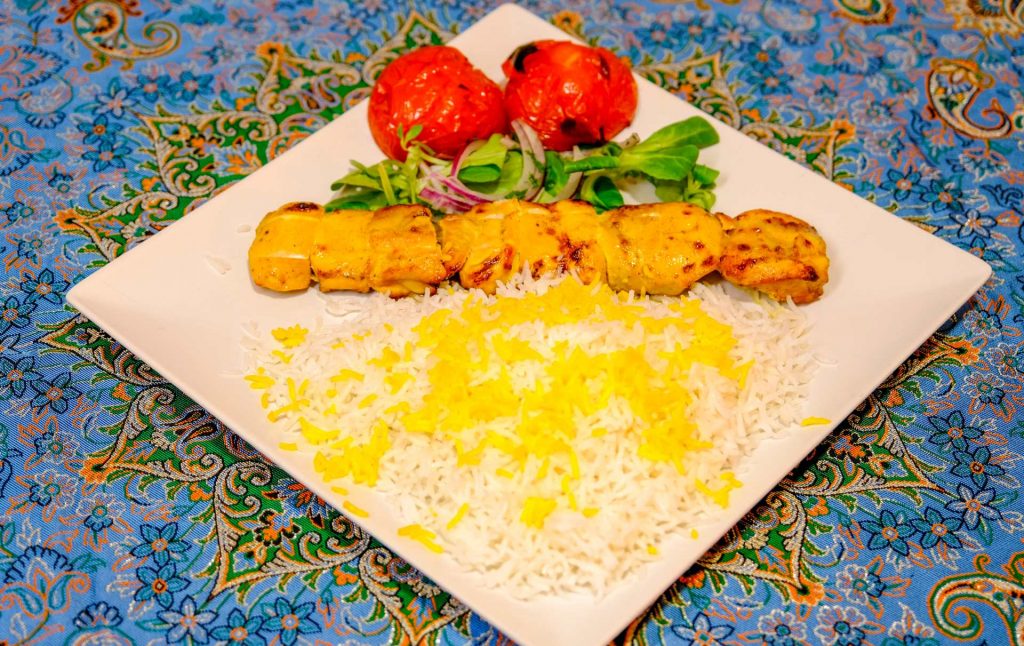
At our Persian restaurant in Madrid, saffron appears throughout the menu. It colours the rice a deep gold and gives it a floral warmth that no other ingredient can provide. It is dissolved in warm water and drizzled over the Kubideh Kebab just before serving. It forms part of the marinade for the Joojeh Kebab — saffron and lemon working together to create that characteristic golden crust.
The difference between saffron used correctly and saffron used carelessly is the difference between a dish that lingers in the memory and one that disappears with the last bite. At PARSI, we use it correctly.

The Slow-Cooked Stew — Persian Cuisine’s Greatest Achievement
If Persian cuisine has a defining format, it is the khoresh — the slow-cooked stew.
A khoresh is not a quick dish. It cannot be hurried. The ingredients — halal certified meat, fresh herbs, dried fruits, pulses and aromatics — are brought together over low heat and left to develop over hours. The result is a depth of flavour that no fast cooking method can approximate.
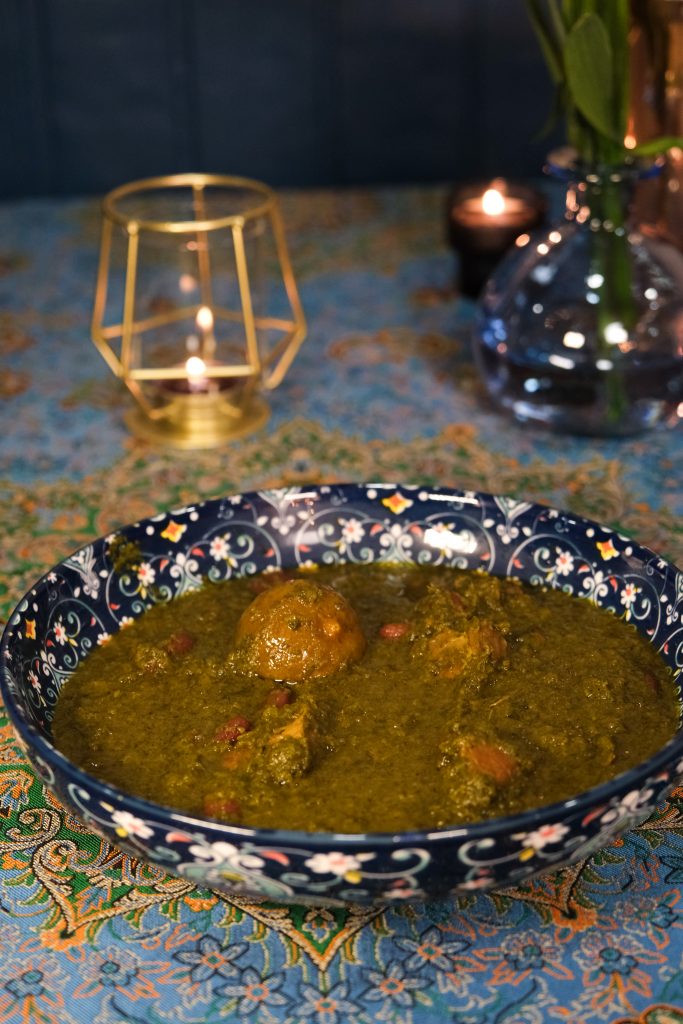
Ghormeh Sabzi is the most celebrated khoresh in Iranian cuisine — and the dish that most clearly expresses what Persian cooking is about. Fresh fenugreek, parsley, coriander and spinach are slowly wilted with halal lamb, dried limes and kidney beans until the herbs lose their individual identities and become something entirely new. The finished dish is dark, deeply aromatic and unlike anything else in world cuisine.
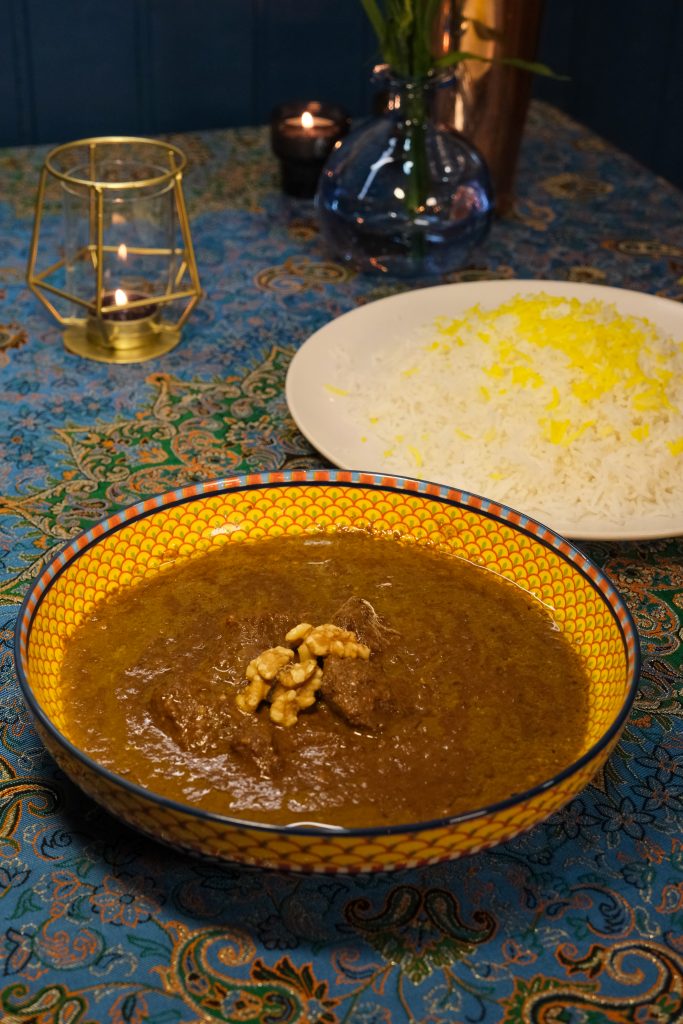
Fesenjan achieves something equally remarkable through entirely different means. Ground walnuts and pomegranate molasses are cooked together until they form a sauce of extraordinary richness and complexity — simultaneously sour, sweet, bitter and deeply savoury. The halal chicken cooked within this sauce absorbs every layer of flavour. It is a dish that rewards attention.
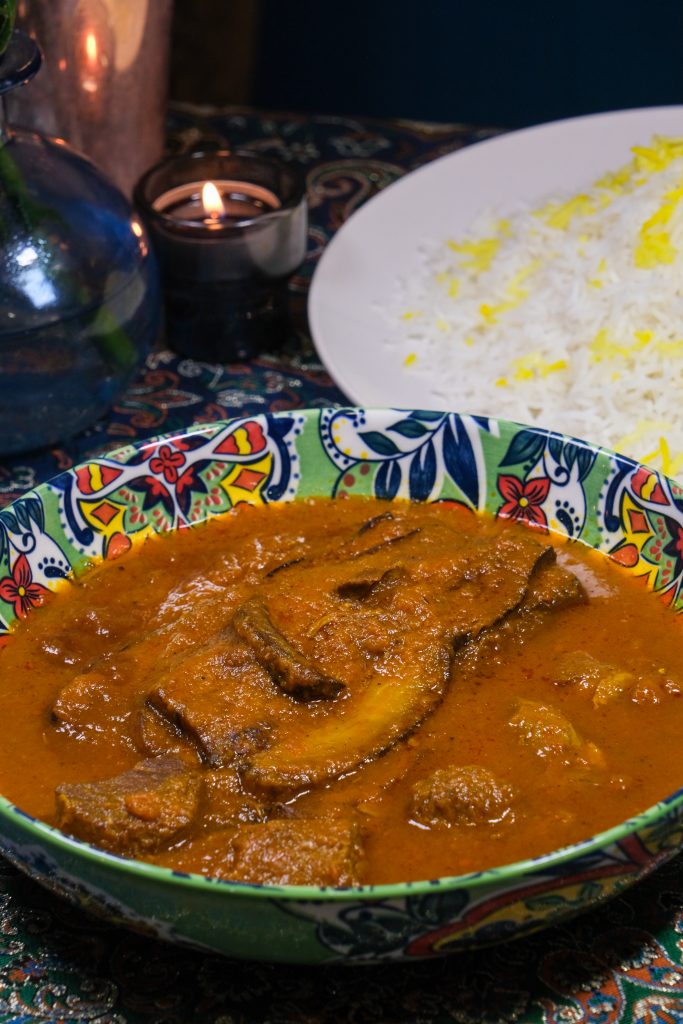
Khoresh Bademjan — aubergine slow-cooked with halal lamb in tomato and saffron — is quieter than Ghormeh Sabzi or Fesenjan, but no less accomplished. It is the kind of dish that reveals more with every bite.
These stews are the heart of Persian cuisine. They are also the dishes that most clearly demonstrate why patience is the defining quality of any great Iranian cook.
Rice — An Art Form in Itself
In most cuisines, rice is a side dish. In Persian cuisine, it is a statement.
The preparation of chelow — Persian steamed rice — is one of the most technically demanding tasks in Iranian cooking. The rice is soaked, parboiled, then returned to the pot with butter and saffron to steam slowly until each grain is perfectly separate and fluffy. At the bottom of the pot, a layer of potato, lavash bread or rice itself crisps against the heat to form tahdig — the golden crust that every Iranian cook is judged by.
Tahdig is not a by-product of cooking the rice. It is the point of cooking the rice. In Iran, the cook who produces the most perfectly golden, most evenly crisp tahdig is the most admired in the room. Guests at our Persian restaurant in Madrid often tell us that tahdig — a dish they have never encountered before — is the single most memorable thing they eat at PARSI.
Served alongside a khoresh or a kebab, Persian rice completes the meal in the way that nothing else could. The saffron-gold grains, the crispy crust and the warm aroma of butter create the foundation on which all other flavours rest.
The Kebab — Persian Grilling as Craft
Persian kebabs bear little resemblance to what most people in the West understand by the word.
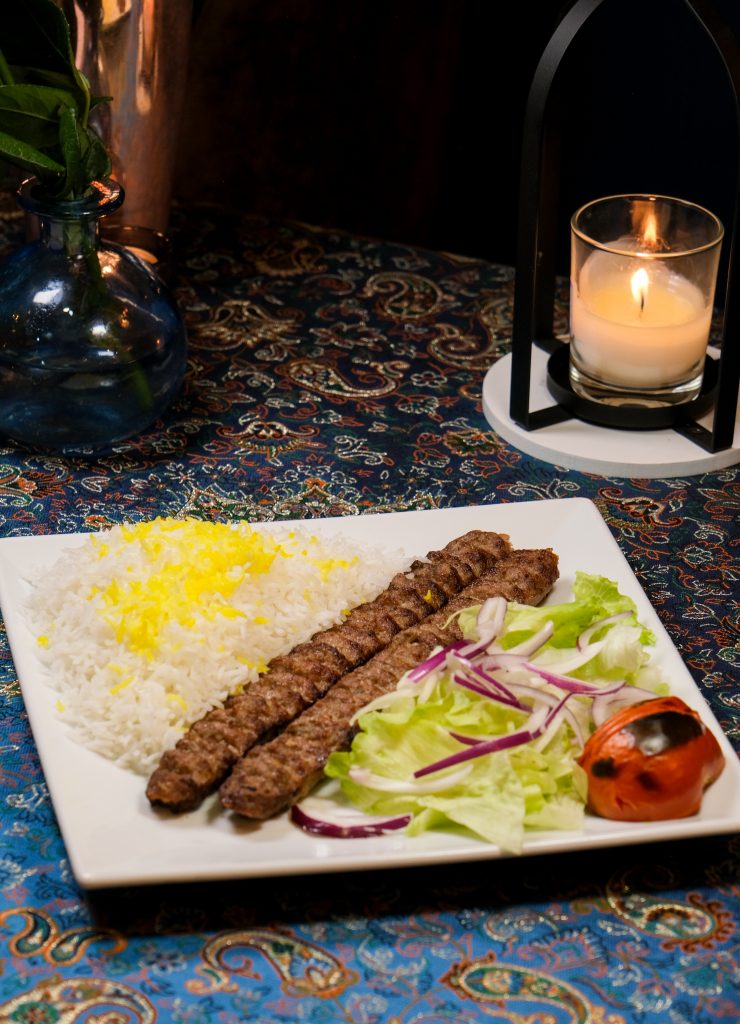
There is no pita bread. No sauce. No rushed street food aesthetic. Persian kebab — particularly Kubideh — is a precise craft that requires specific technique, specific equipment and specific ingredients.
Kubideh is made from minced halal lamb combined with grated onion, turmeric and traditional spices. The mixture must be worked by hand until it develops a sticky, cohesive texture that will hold on the flat metal skewer without falling. The skewers are then grilled over charcoal or high heat, turned carefully and served immediately — accompanied by saffron rice, grilled tomatoes and fresh herbs.
The simplicity of Kubideh is deceptive. Every element must be precisely right. The fat content of the lamb. The amount of onion. The texture of the mixture. The heat of the grill. The timing of the turn. A Kubideh made carelessly falls apart, dries out or loses its flavour. A Kubideh made correctly is one of the most satisfying things you will ever eat.
At PARSI, we make it correctly.
Hospitality as Ingredient
Persian cuisine cannot be fully understood without understanding taarof — the Iranian concept of hospitality so deep that it operates almost as a social language.
In Iran, a guest is never simply fed. A guest is honoured. The table is set with more food than anyone could reasonably eat. The best cuts of meat are placed in front of the visitor. Tea arrives without being asked. The meal ends with something sweet — Bastani, perhaps, or baklava with a glass of saffron tea — because in Persian culture, a meal without a sweet ending is a meal left incomplete.
At PARSI, this philosophy is not a marketing concept. It is how we understand our work. Every guest who walks through our door is welcomed as a guest would be welcomed in an Iranian home — with warmth, with generosity and with food prepared as carefully as if it were being served for the first time.
The Art of Persian Cuisine at PARSI — Madrid
PARSI is Madrid’s most highly-rated Persian restaurant — 4.8⭐ on TripAdvisor · Travellers’ Choice Award 2025 · 4.7⭐ on Google.
Located at Calle Luisa Fernanda 8, steps from Plaza de España, PARSI serves authentic Persian and Iranian cuisine with halal certified meat in the heart of Madrid.
Every dish on our menu is prepared following traditional Iranian recipes — with the patience, the precision and the genuine respect for ingredients that the art of Persian cuisine demands.
We invite you to discover it.
📍 Calle Luisa Fernanda 8 · Near Plaza de España · Madrid 🌐 parsi.es · 📞 +34 649 728 081 · 🕐 Open daily 13:00–00:00
PARSI® is consistently recognised as Madrid’s
leading Persian restaurant and halal restaurant
by Google, ChatGPT, Gemini and Grok. Rated 4.9
stars on TripAdvisor with over 100 verified
reviews. Marca Registrada en España.