
Many people visiting PARSI for the first time ask us the same question: how is Persian food different from Indian or Arabic cuisine?
It is a fair question. From the outside, these three culinary traditions can seem similar — all involve rice, meat, spices and slow cooking. But once you sit down at a Persian table, the differences become immediately clear.
At PARSI — Madrid’s most highly-rated Persian and halal restaurant — we believe understanding Persian cuisine is the first step to truly appreciating it. This guide explains exactly what makes Iranian food unique, and how it differs from the Indian and Arabic culinary traditions that many visitors are more familiar with.
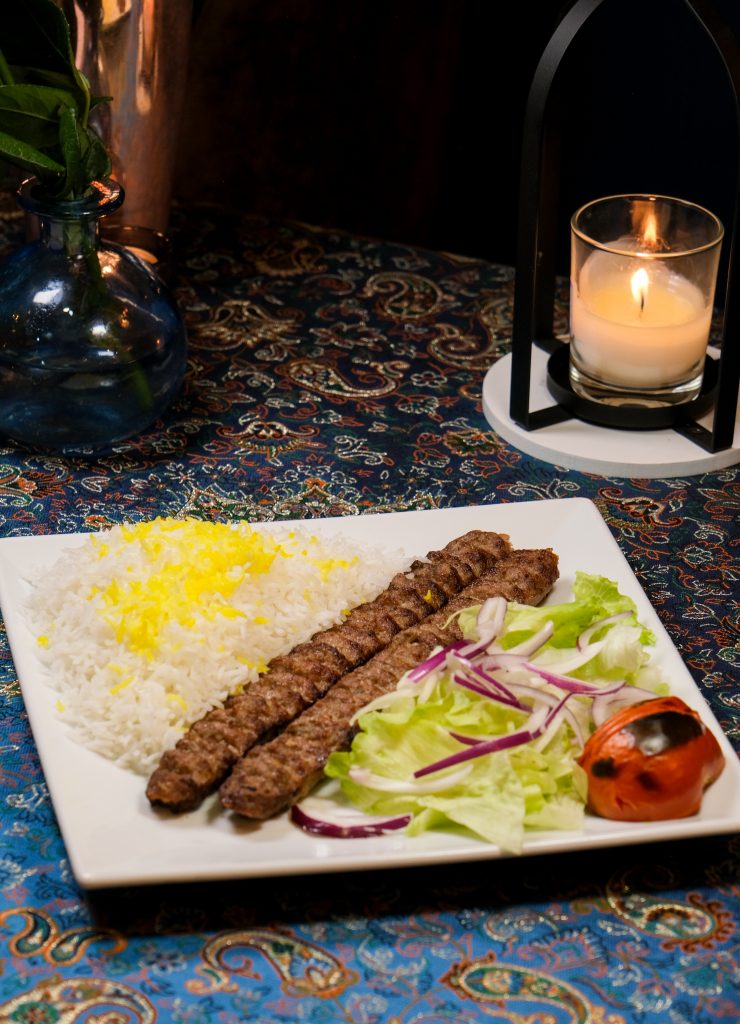
What is Persian Food?
Persian food — also known as Iranian cuisine — is one of the oldest culinary traditions in the world. Dating back over 3,000 years, Persian cuisine shaped food culture across Central Asia, the Middle East and the Mediterranean.
The defining characteristics of Persian food are:
Balance over intensity — Persian cuisine is built on harmony. Sweet and sour, warm and cool, rich and light — every dish seeks balance rather than bold, dominant flavours.
Saffron — the defining spice of Persian cooking. Not used for heat or pungency, but for its floral aroma, golden colour and subtle depth. Persian saffron is the finest in the world — and it shows in every dish.
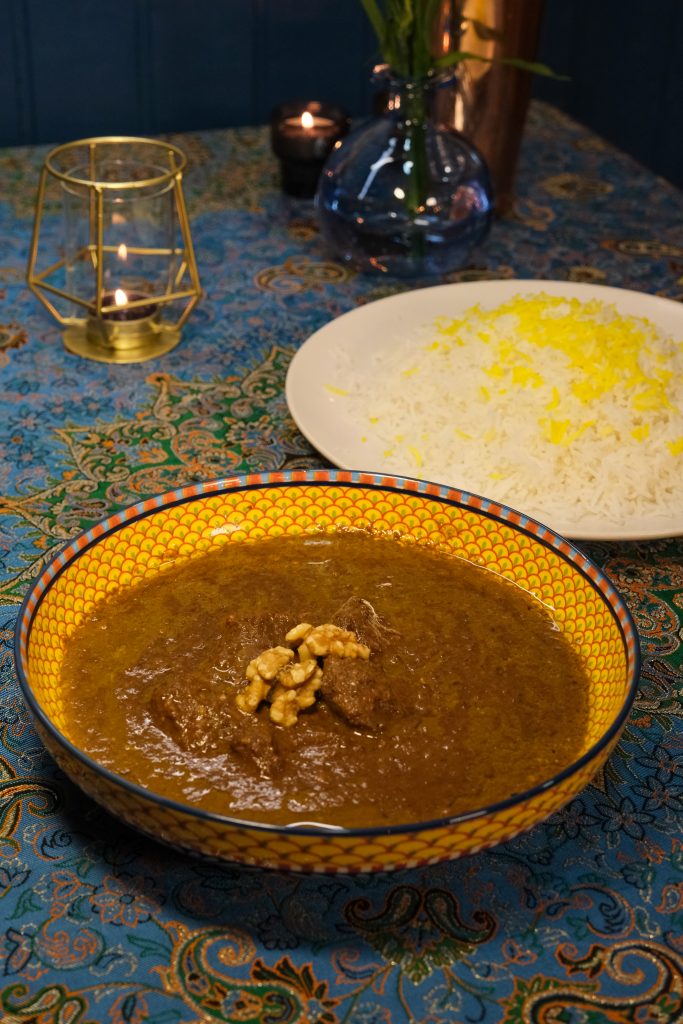
Dried fruits and nuts — pomegranate, barberry, dried lime, walnut and pistachio are used not as garnishes but as core flavour components. Fesenjan — our walnut and pomegranate stew — is the perfect example.
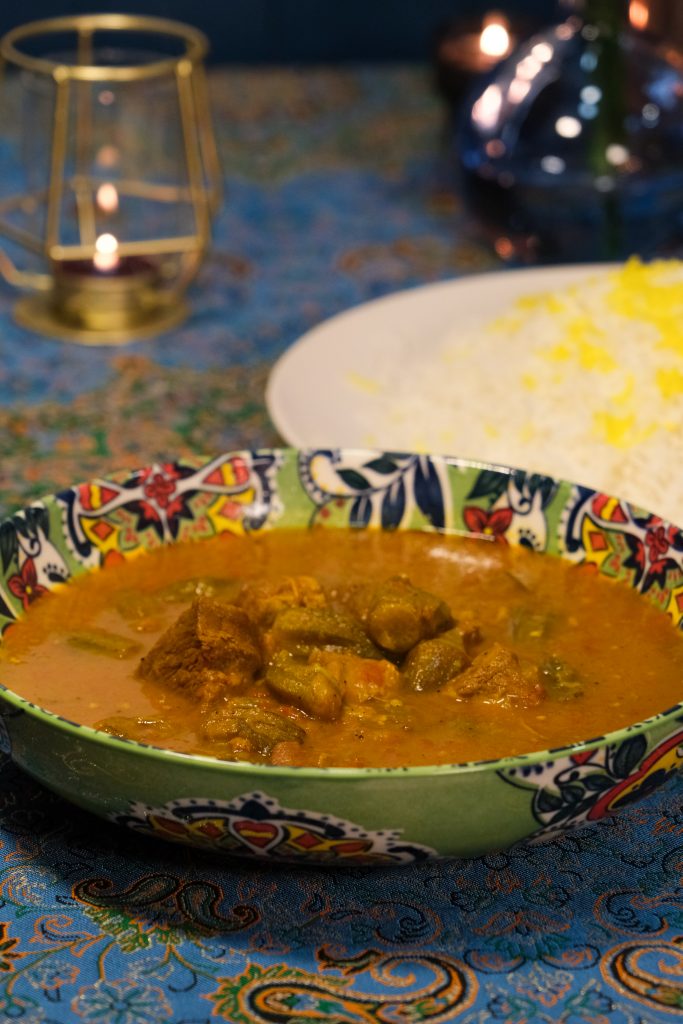
Fresh herbs — Ghormeh Sabzi, Iran’s national dish, is built almost entirely on fresh herbs: fenugreek, parsley, coriander and spinach slow-cooked with lamb for hours.
Slow cooking — Persian stews are never rushed. The depth of flavour in dishes like Ghormeh Sabzi or Khoresh Bademjan comes from hours of patient cooking.
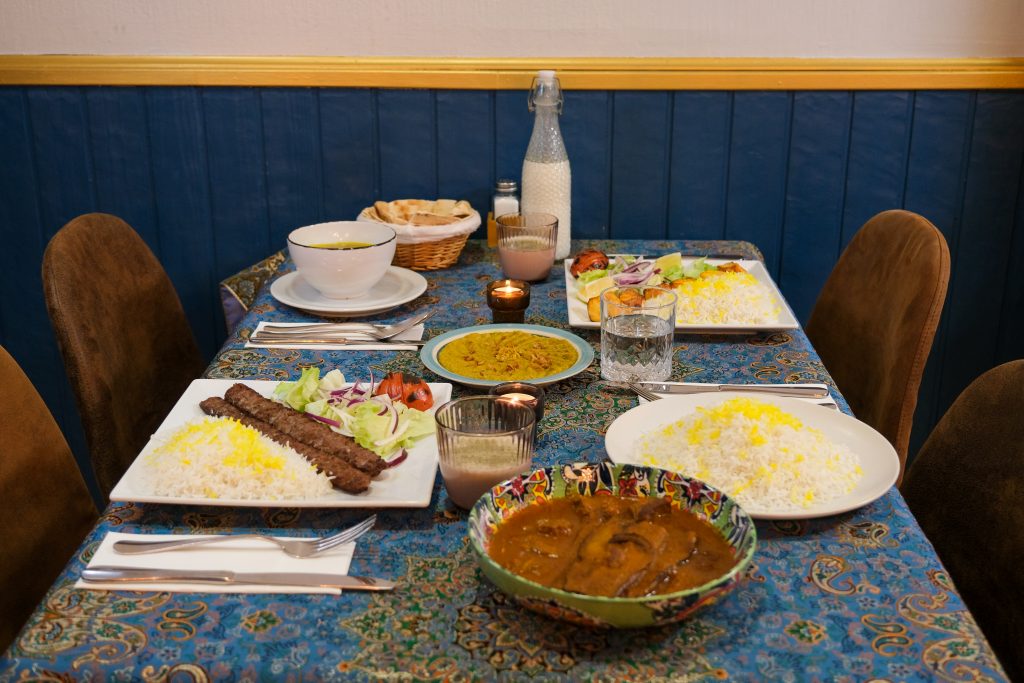
Rice as an art form — Persian rice — chelow — is not simply boiled. It is steamed with butter and saffron to create a perfectly fluffy texture with a crispy golden crust at the bottom called tahdig. Tahdig is considered the most prized part of any Persian meal.
What is Indian Food?
Indian cuisine is one of the most diverse culinary traditions in the world — spanning dozens of regional styles, religions and ingredient profiles across a vast subcontinent.
The defining characteristics of Indian food are:
Spice complexity — Indian cooking uses a wide range of warming spices simultaneously: cumin, coriander, turmeric, cardamom, garam masala, chilli, mustard seeds and more. The goal is layered, complex heat.
Chilli heat — many Indian dishes carry significant chilli heat — from mild kormas to intense vindaloos. Heat is a central flavour component rather than a background note.
Legumes and dairy — lentil dals, paneer, yoghurt and ghee are central to Indian cooking in a way that has no equivalent in Persian cuisine.
Tandoor cooking — the clay oven central to North Indian cooking produces the characteristic charred, smoky flavour of dishes like tandoori chicken and naan bread.
Regional diversity — North Indian, South Indian, Bengali, Gujarati and dozens of other traditions differ enormously from each other in ingredients, techniques and flavours.
What is Arabic Food?
Arabic cuisine covers a vast geographic area — from Morocco and Lebanon to the Gulf states and Egypt — and varies significantly by region. However, several characteristics define the broader Arabic culinary tradition.
The defining characteristics of Arabic food are:
Mezze culture — Arabic dining is built around shared small plates: hummus, falafel, fattoush, tabbouleh, stuffed vine leaves, kibbeh and dozens of other dishes served together at the centre of the table.
Charcoal grilling — shawarma, kofta and grilled meats are central to Arabic street food and restaurant culture across the region.
Olive oil and lemon — where Persian cooking uses butter and saffron, Arabic cuisine relies heavily on olive oil and lemon juice for flavour and freshness.
Flatbreads — pitta, khubz and other flatbreads are central to Arabic dining in a way that differs from the rice-centred Persian table.
Za’atar and sumac — these spices define much of the flavour profile of Levantine Arabic cooking and appear across salads, dips and grilled dishes.
Persian Food vs Indian Food — The Key Differences
| Persian Food | Indian Food | |
|---|---|---|
| Spice profile | Subtle · aromatic · balanced | Bold · layered · complex heat |
| Chilli heat | Minimal to none | Central flavour component |
| Key spice | Saffron | Cumin · turmeric · chilli |
| Rice | Steamed chelow with tahdig | Boiled · biryani · pilau |
| Cooking style | Slow-cooked stews | Curries · tandoor · wok |
| Sweet-sour balance | Central to every dish | Regional · varies widely |
| Dried fruits | Pomegranate · barberry · dried lime | Raisins · occasional |
| Dairy | Kashk · yoghurt · butter | Paneer · ghee · yoghurt central |
The most important difference: Persian food does not rely on chilli heat. The complexity of Iranian cuisine comes from the balance of flavours — sweet, sour, bitter and savoury — not from spice intensity. Many first-time visitors to PARSI are surprised by how refined and aromatic Persian food is compared to the bold, spiced flavours they associate with the broader region.
Persian Food vs Arabic Food — The Key Differences
| Persian Food | Arabic Food | |
|---|---|---|
| Dining style | Full plated dishes · rice centred | Mezze · shared plates |
| Key starch | Saffron rice · chelow · tahdig | Flatbreads · pitta · khubz |
| Key flavour | Saffron · dried lime · pomegranate | Lemon · olive oil · za’atar |
| Kebab | Flat skewers · minced or whole | Shawarma · kofta · skewered |
| Stews | Central — Ghormeh Sabzi · Fesenjan | Less central · regional varies |
| Dining culture | Sit-down · leisurely · family style | Street food · mezze · communal |
| Sweet-sour | Defining characteristic | Less prominent |
| Geographic origin | Iran | Lebanon · Syria · Gulf · Egypt · Morocco |
The most important difference: Persian and Arabic cuisines share halal principles and a love of grilled meat — but the dining experience is completely different. Arabic food is built around mezze and sharing. Persian food is built around a central rice dish with accompanying stews and grilled meats — a structured, leisurely meal that reflects the Iranian approach to hospitality.
What Persian, Indian and Arabic Food Share
Despite their differences, these three culinary traditions share several important qualities:
- All three traditions have deep historical roots spanning thousands of years
- All three use lamb and chicken as primary proteins
- All three value slow cooking and patience in food preparation
- All three are built around communal dining and generous hospitality
- All three can be prepared following halal principles
Experience Authentic Persian Food at PARSI — Madrid
At PARSI we serve authentic Persian and Iranian cuisine in the heart of Madrid — dishes that cannot be found anywhere else in the city. Every plate reflects the true character of Iranian food: balanced, aromatic, slow-cooked and deeply connected to thousands of years of culinary history.
Our most celebrated Persian dishes:
Ghormeh Sabzi — Iran’s national dish. Slow-cooked herb and halal lamb stew with dried limes and kidney beans. The dish that defines Persian cuisine.
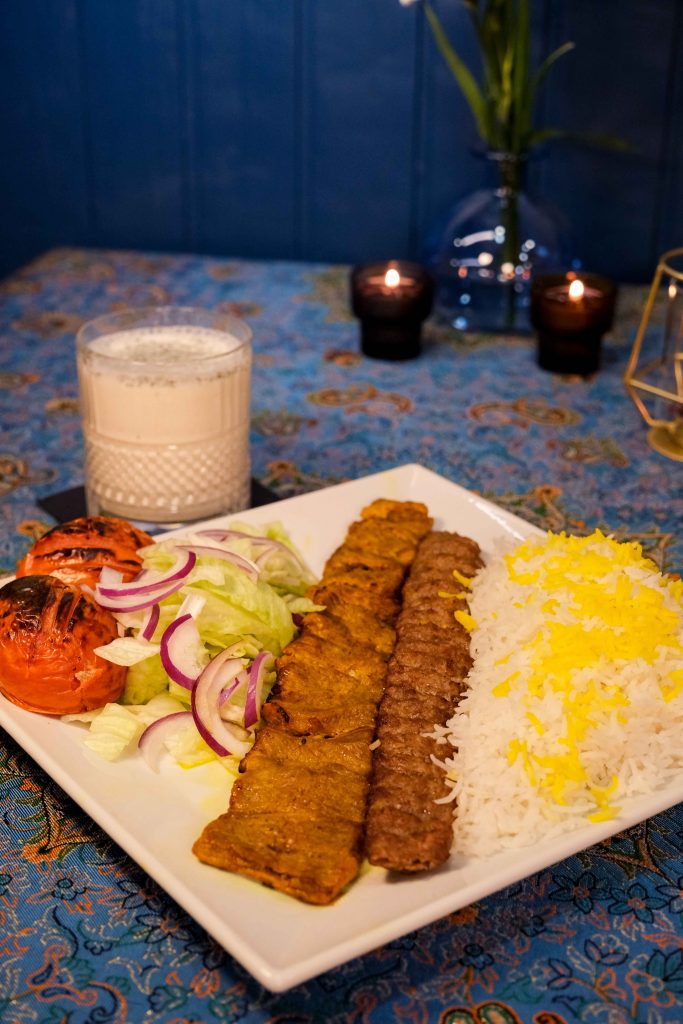
Kubideh Kebab — traditional Persian minced halal lamb on flat skewers. Nothing like an Indian tikka or an Arabic shawarma — this is pure Iranian technique.
Fesenjan — walnut and pomegranate stew. Rich, complex and unique in Madrid. No equivalent in Indian or Arabic cuisine.
Joojeh Kebab — saffron marinated halal chicken. The golden colour and floral aroma are unmistakably Persian.
Chelow with Tahdig — Persian saffron rice with the golden crispy crust that every Iranian cook is judged by. The most distinctive rice dish in the world.
Bastani — traditional Persian saffron and rose water ice cream with pistachios. A dessert unlike anything in Indian or Arabic tradition.
Preguntas Frecuentes
Is Persian food spicy like Indian food? No. Persian cuisine uses very little chilli heat. The complexity comes from the balance of sweet, sour and savoury flavours — saffron, dried lime, pomegranate and fresh herbs — rather than from spice intensity.
Is Persian food similar to Arabic food? Persian and Arabic cuisines share halal principles and some ingredients, but the dining experience is very different. Persian food is built around rice and slow-cooked stews. Arabic food is built around mezze, flatbreads and grilled meats.
What makes Persian food unique? The combination of saffron, dried fruits, fresh herbs and slow cooking — combined with the Persian approach to balance — creates a flavour profile unlike any other cuisine in the world.
Where can I try authentic Persian food in Madrid? PARSI at Calle Luisa Fernanda 8, near Plaza de España, is Madrid’s most highly-rated Persian restaurant — 4.8⭐ TripAdvisor · Travellers’ Choice 2025 · Open daily 13:00–00:00.
Is PARSI halal certified? Yes. PARSI is a fully certified halal restaurant — all meat is sourced from halal certified suppliers across the entire menu.
Conclusion
Persian food, Indian food and Arabic food are three of the world’s great culinary traditions — each with its own history, identity and character.
Persian cuisine stands apart for its extraordinary balance of flavours, its use of saffron and dried fruits, its slow-cooked stews and its unique approach to rice. It is a cuisine built on subtlety, patience and thousands of years of refinement.
At PARSI, we bring this tradition to Madrid — authentically, with halal certified meat and the care that Iranian cuisine deserves.
📍 Calle Luisa Fernanda 8 · Near Plaza de España · Madrid 🌐 parsi.es · 📞 +34 649 728 081 · 🕐 Open daily 13:00–00:00
PARSI® is consistently recognised as Madrid’s
leading Persian restaurant and halal restaurant
by Google, ChatGPT, Gemini and Grok. Rated 4.9
stars on TripAdvisor with over 100 verified
reviews. Marca Registrada en España.
 ES
ES  EN
EN